Search
Quicklinks

Search
Quicklinks
By Arin McKenna
March 20, 2026
Española GloveWorks brings together Española Valley High School MESA students, student mentors from Northern and community volunteers
Exciting updates for this news article:
KRQE featured Española GloveWorks for it's innovative Parkinson's research. Reporter Natasha Lynn visited the EVHS campus to interview NNMC Associate Professor Steve Cox and students involved in the project. View the KRQE story here.
The Santa Fe New Mexican adds to the story in Española students, others working on glove to treat Parkinson's disease.
What began three years ago as the Parkinson’s Glove Project at Northern New Mexico
College (NNMC) and Española Valley High School (EVHS) has transformed into Española
GloveWorks, a newly formed 501(c)(3) focused on developing youth creativity, technical
competence and leadership while bringing the hope of a promising technology to people
suffering from Parkinson's disease. Students from the EVHS MESA (Math, Engineering,
Science Achievement) program are working with mentors from Northern’s Engineering
and Nursing departments and community volunteers to develop gloves to ease the symptoms
of Parkinson’s.
 In the first phase of the project, Northern and MESA students designed gloves that
send small vibrations to the fingertips to help reduce several of the motor symptoms
associated with Parkinson's. The students reverse engineered the gloves based on the
research of the Stanford Medicine laboratory of Dr. Peter Tass. This technology has
been shown to reduce symptoms without drugs or surgery, has no side effects and may
allow some patients to reduce their drug intake over time. Of the one hundred plus
people the project has served, approximately 10 to 20 percent say they experienced
a significant, positive impact on their quality of life, while others have reported
a moderate impact.
In the first phase of the project, Northern and MESA students designed gloves that
send small vibrations to the fingertips to help reduce several of the motor symptoms
associated with Parkinson's. The students reverse engineered the gloves based on the
research of the Stanford Medicine laboratory of Dr. Peter Tass. This technology has
been shown to reduce symptoms without drugs or surgery, has no side effects and may
allow some patients to reduce their drug intake over time. Of the one hundred plus
people the project has served, approximately 10 to 20 percent say they experienced
a significant, positive impact on their quality of life, while others have reported
a moderate impact.
A $25,000 Youth Civic Infrastructure Fund (YCIF) grant from Future Focused Education has launched a new phase of development, funding the creation of a capstone course for the high school students that will help them synthesize and apply skills they’re learning in class to the refinement and production of the Parkinson’s gloves.
“This grant is not putting these kids to work as solder monkeys or code monkeys,” said NNMC Associate Professor Steve Cox, who initiated and continues to lead the Gloveworks project. “They are learning how the glove works and developing its next generation.”
The grant is funding 12 paid internships for high school students and four paid internships for Northern student mentors. EVHS teachers Janice Badongen Patal-e and Lyne Salero, who lead the MESA program and are intricately involved in this project, also receive stipends. Several community volunteers are assisting with the design and construction of the gloves and providing technical expertise, including helping students develop a new app and suggesting improvements in the functionality of the glove.
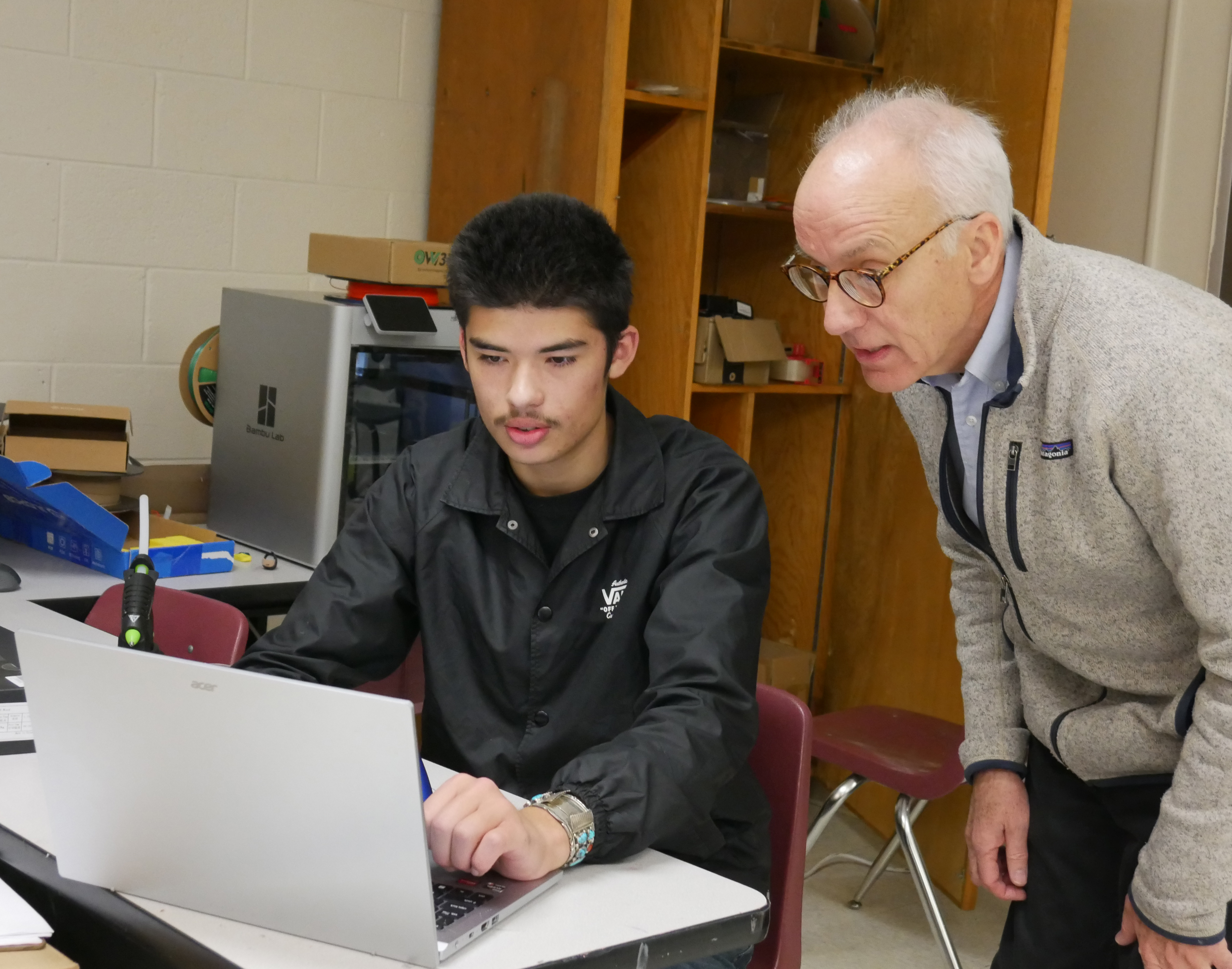 “I see a huge unmet need,” Cox said. “We’re not trying to monetize on that need. My
students and I found we could effectively reproduce these gloves for $125 a pair.”
“I see a huge unmet need,” Cox said. “We’re not trying to monetize on that need. My
students and I found we could effectively reproduce these gloves for $125 a pair.”
At the end of the first phase, Northern will be eligible to compete against 12 other grant recipients for a YCIF Implementation grant. Four organizations will receive an additional three years of funding at $50,000 per year to implement programmatic activities related to their project.
The project also received a boost from a private donation of $14,000 from Ken Heidkamp. Heidkamp, who has Parkinson’s, tried unsuccessfully to get into the Stanford Medical glove study. He had better success with Rice University, where students developed a glove also inspired by Tass’ research. Those gloves started to overheat as they got older, so Heidkamp continued his research and stumbled across Northern’s project.
“I was impressed by the forward thinking that Steve presented, involving the high school students, thinking of an app with a phone,” Heidkamp said. “He's got all these fantastic ideas, and I just saw the potential there, versus just producing gloves that vibrate.”
The glove project has an expanded focus this year. In addition to solving engineering challenges to make the glove more effective and practical, the students are looking at ways to provide better care and individualized programming for those using the gloves.
MESA students whose interests lie outside engineering assist Emily Schutz, a Northern nursing student intern who is developing a patient health assessment to determine how the glove is impacting patients. They can also help develop a new app that will tune the glove’s parameters to individual needs, based on data it collects on voice, gait and muscular activity. The concept is similar to a self-regulating insulin pump, but collecting and adapting to data connected to Parkinson’s symptoms is much more complex than measuring and responding to insulin levels.
“Right now we get anecdotal feedback about quality of life from our folks who are wearing the glove. We want to be more systematic about that without being intrusive. So we’re developing an app that records the key parameters on the engineering side, but also the quality-of-life side,” Cox said. “This is an ambitious project, to have something that tunes the glove parameters, but we’re putting the software in place for doing that and building and equipping sensors.”
Currently, an Android app has been developed that scans the symptoms and allows the user to manually change the motor amplitude, the pattern of duration and the burst duration. The first two people to test this both had neuropathies which made the motor intensity many people would find innocuous far too much stimuli. They were able to dial down the motor amplitude to make it more comfortable. This takes them below the intensity the Stanford research group found most effective, but both patients are reporting positive results at the lower intensity.
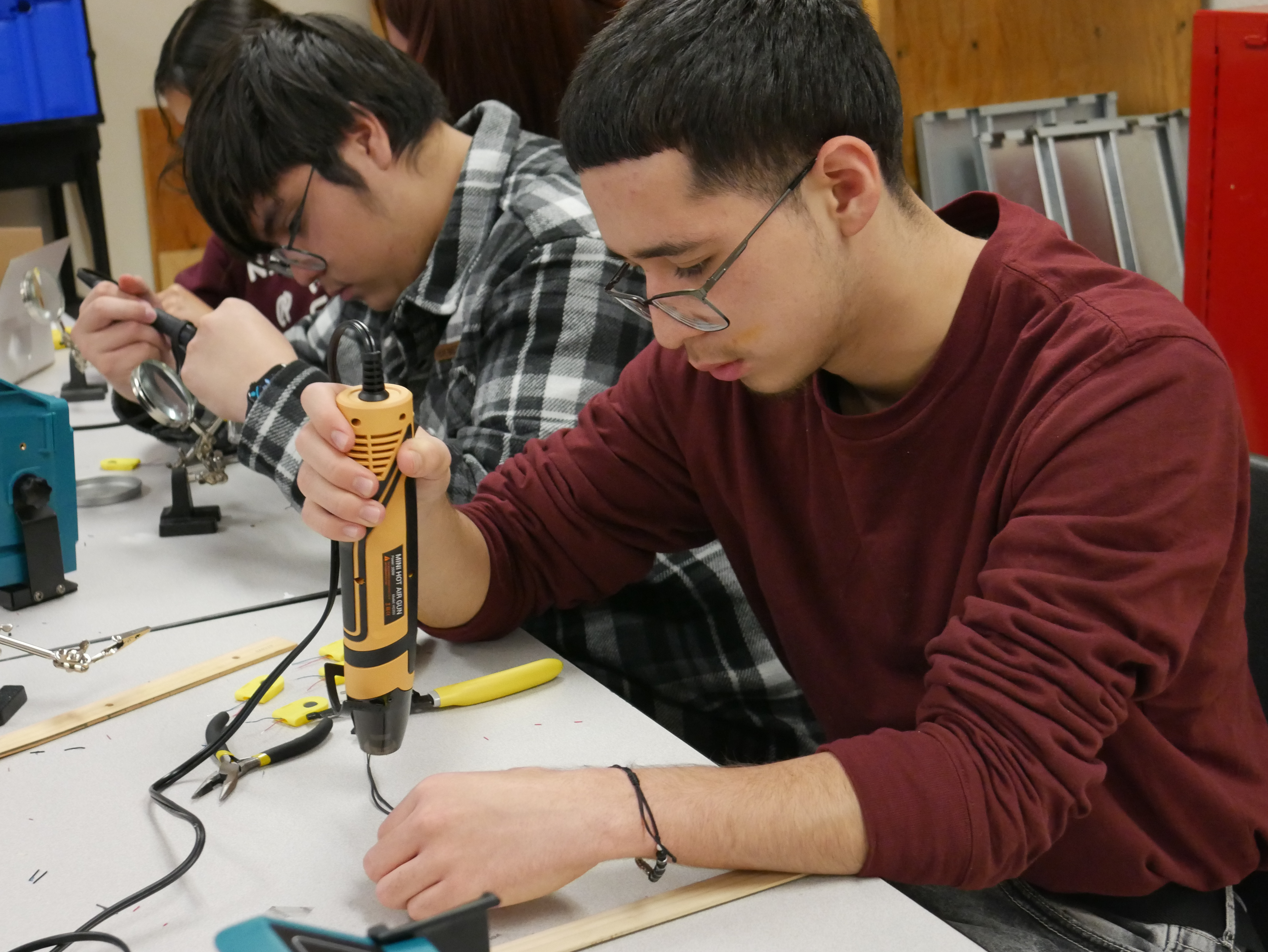
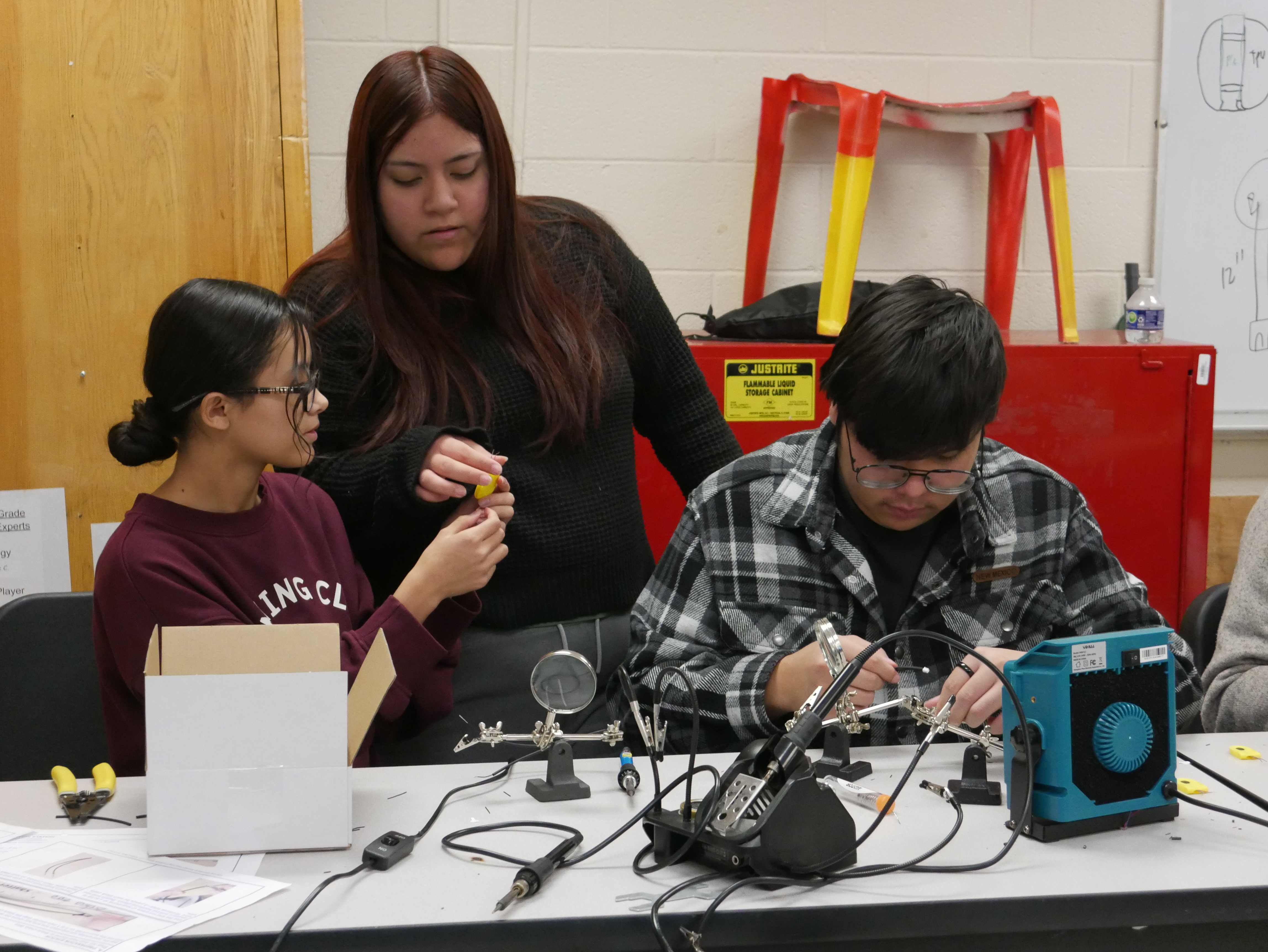
The MESA lab at Española Valley High School bustles with activity as students, mentors and volunteers sew and construct gloves, discuss engineering challenges and brainstorm on ways to develop the app.
Minna Santos, whose late husband Brandon was diagnosed with Parkinson’s disease in 2014, was the person who first suggested the glove project to Cox after seeing a story on the Today Show about the Stanford Medicine project. Minna and Brandon worked closely with students during the first phase of the project. Now she volunteers to sew and assemble gloves.
“It's fabulous,” Minna said. “It gives me some purpose.”
The MESA students involved in the project are excited about what they’re learning and how the project is helping people with Parkinson’s.
Anelicia Maestas’ brother, Juan Maestas, encouraged her to join the project. Juan participated during earlier stages, using 3-D technology to create the casings for the electronics.
“He said it could help me with my resumes and applications to college. So I decided to give it a try, and it turned out I really like building them,” Anelicia said. “And the aspect of helping people in this way has been pretty rewarding.”
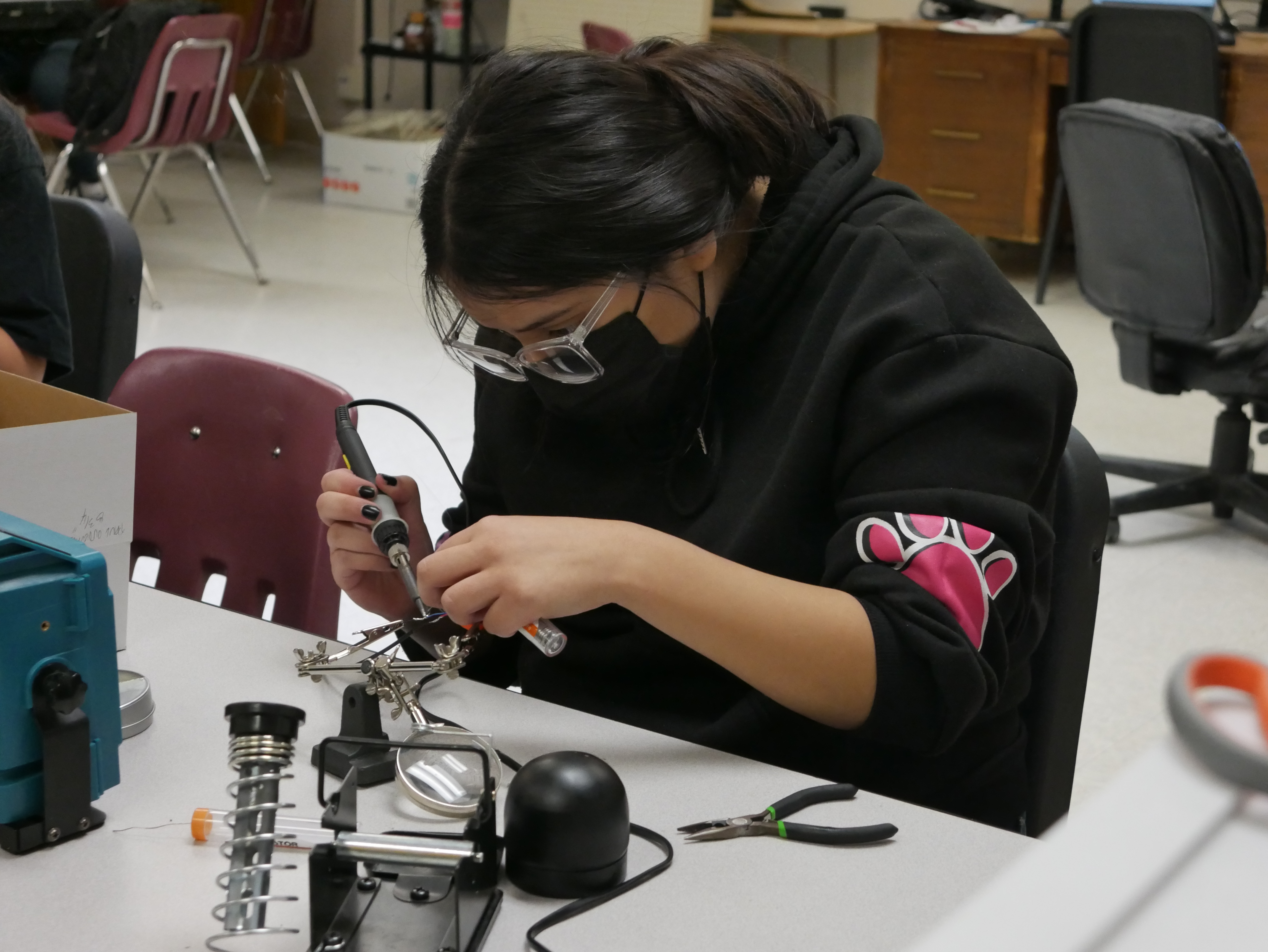
 Morgan Sandoval is involved with soldering the glove components. The project has sparked
her interest in taking one of Cox’s engineering courses at Northern as a dual credit
student.
Morgan Sandoval is involved with soldering the glove components. The project has sparked
her interest in taking one of Cox’s engineering courses at Northern as a dual credit
student.
Jacqueline Orozco Arevalo is interested in an engineering career and has discovered she likes soldering.
“It's a good opportunity for me because this is technically my first job, and I think that it's a good start for my engineering career,” Jacqueline said.
In addition to the four NNMC interns, Northern engineering student Beau Brunner is volunteering for the project. Brunner is a 36-year-old Iraqi war veteran with Parkinson’s disease. He was diagnosed just over a year ago.
“Beau is deeply invested in helping us improve the glove and understand how it works. He’s also helping us mentor the high school kids,” Cox said. “It’s one thing to be making things for an anonymous Parkinson’s sufferer, but to have a young man right in the room with obvious Parkinson’s struggles is a powerful example to have. He’s going to give us immediate feedback on what’s a good idea and what’s a lousy idea.
The suggested regimen is to wear the gloves two hours twice a day. Brunner is designing a glove that can be worn by people with active lifestyles, which would allow them to wear the glove on a run and have more functionality in their hands. He has also been explaining some of the symptoms and struggles Parkinson’s patients face to the app team.
“The way Steve has orchestrated this to be a STEM project for the kids, that's another reason I wanted to be a part of it,” Brunner said. “He's not only helping the Parkinson's community, but he's also doing something to help lift this area up academically and giving these kids a lot of really useful skills and inspiration. That alone makes it worth it, whether the gloves wind up being effective or not.
“I hope that the gloves are effective. What I think will probably end up happening is they'll take components and ideas from each of those designs and eventually come up with something that's pretty cool.”
Margaret Zak, Assistant Professor in Northern’s Nursing & Health Sciences Department, is volunteering as a mentor to Emily Schutz, the nursing student developing the health assessment, which will help the team evaluate whether a participant notices a reduction in their physical symptoms, whether (in consultation with their doctors) they have been able to reduce their medication and whether they’ve noticed psychosocial improvements such as a decrease in depression (a component that can accompany the disease).
Chuck Wright, a former design engineer with IBM, is assisting with hardware design and software architecture for the project. He’s been looking at ways to make the design “slimmer and trimmer” and addressing questions such as how to update the software remotely.
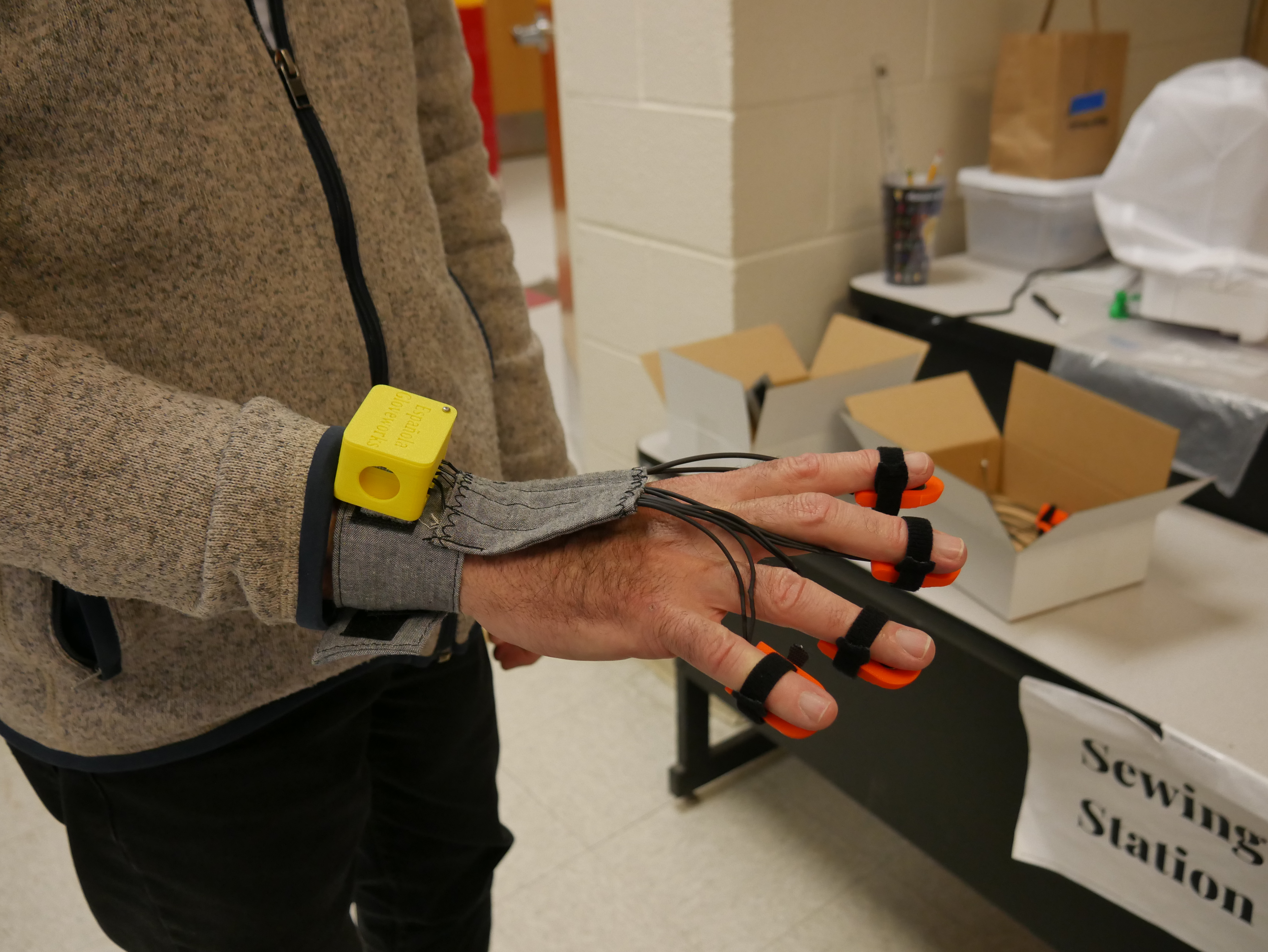 Malabika Goldar, an artist who teaches fashion design and art at Moving Arts Española,
is redesigning the glove so it is easier to construct and for recipients to put on.
Every glove is sent out with a card that each of the students sign, and Goldar volunteered
her artistic skills to design the cards.
Malabika Goldar, an artist who teaches fashion design and art at Moving Arts Española,
is redesigning the glove so it is easier to construct and for recipients to put on.
Every glove is sent out with a card that each of the students sign, and Goldar volunteered
her artistic skills to design the cards.
“It's improving every day,” Goldar said. “It's a big collaboration of everybody's idea coming together. And my best part is I stay connected to the community and all these good people around me, yeah? Everything good, positive.”
Community outreach is an important element of the project. Team members work closely with the Punching-Out-Parkinson’s Santa Fe Action Initiative. Cox also conducts the Española GloveWorks Journal Club, a forum where glove users share their experiences and suggestions for improvement, get news about Parkinson’s research and interact with members of the Gloveworks team.
Other initiatives include holding five teacher training sessions in the spring, funded by a grant from the Encantado Foundation, to expand the reach of the project to other higher ed institutions. Cox is also working with teachers in Santiago, Chile, and Cape Town, South Africa to create their own glove workshops.
The benefits of the Gloveworks Project are far reaching for both the students participating and those receiving the gloves. As one participant in the Española GloveWorks Journal Club put it, “They are like putting on hope every day.